Aqara’s new Spatial Multi-Sensor FP400 is built to track up to 10 people in a room and still work with platforms like Home Assistant, Apple Home, Alexa, Google Home, Homey, and SmartThings. The company says the FP400 uses 60GHz mmWave radar to tell whether people are actually present, not just moving, so lights and other automations can stay on even when someone is sitting still. It covers a room up to about 860 square feet from a single unit, supports multiple zones for more precise automations, and connects over Thread or Zigbee with Matter support. It is now available through Aqara’s own website, Amazon, and other authorized retailers in the United States and several other countries.
Aqara FP400: A higher-capacity presence sensor for the home
The FP400 is a ceiling or wall mounted 60GHz mmWave radar presence sensor designed to watch a whole room and figure out whether people are actually there. Unlike a simple motion sensor that only reacts to movement, it can keep detecting someone who is working at a desk, watching TV, or reading without moving around much. Aqara positions the FP400 above its earlier FP2 and FP1E sensors in the same family, with a higher capacity for tracking more people in a larger area.
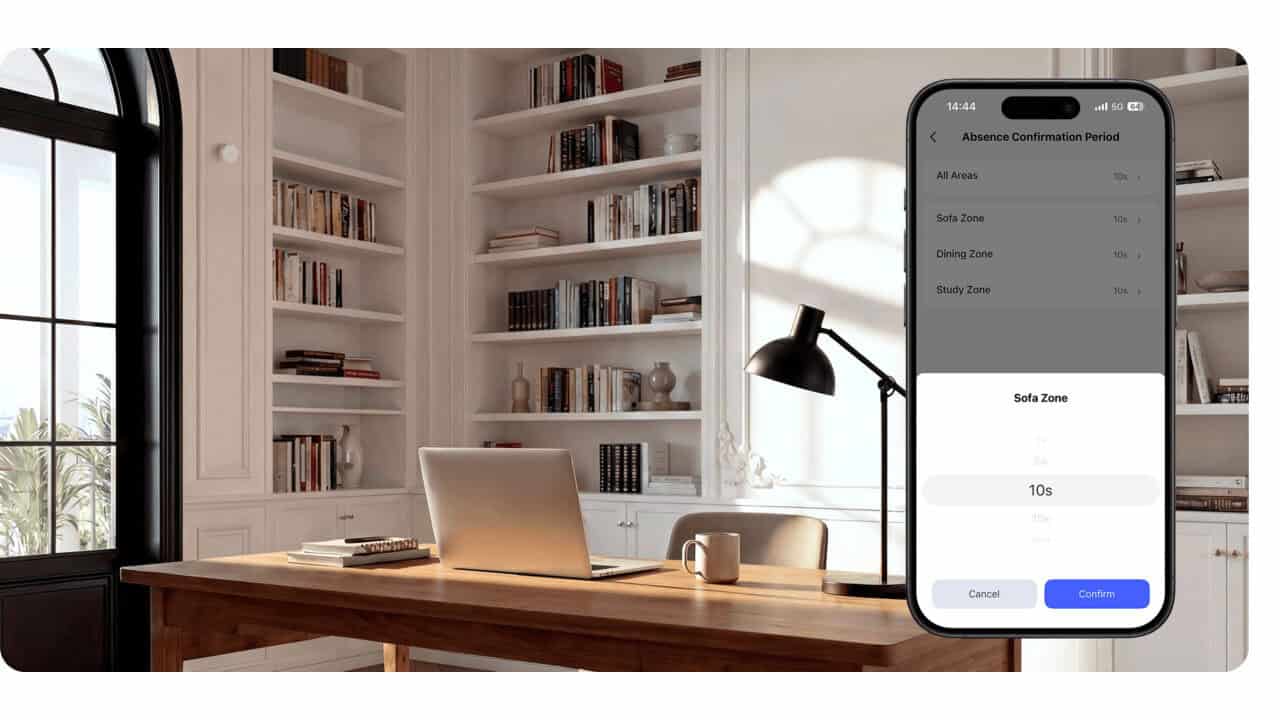
Aqara states that the FP400 can track up to 10 people at the same time within its detection area. That level of tracking is aimed at busy spaces such as living rooms, open-plan areas, or home offices where multiple people may come and go. The sensor also supports up to 8 separate zones, which can be used to set up localized automations inside a single room, such as different behaviors for a couch area, dining table, or entryway.
Room coverage, zones, and mounting options
According to Aqara, a single FP400 can cover an area up to 10 meters by 8 meters, which is roughly 860 square feet. The stated 120-degree field of view is intended to let one sensor watch most of a normal-sized room when it is placed in a good location. The support for up to 8 zones means the coverage can be broken up inside that space, so different parts of the room can trigger different actions.
The FP400 can be mounted on a ceiling, on a wall, or tucked into a corner, giving some flexibility in how it is installed. Placement matters with mmWave sensors, and Aqara’s own figures move with it: the 10 by 8 meter maximum is the side-mounted rating, corner mounting is quoted at 7 by 7 meters, and a ceiling mount at 3 meters covers about 5 by 6 meters for motion and 4 by 5 meters for presence directly below. There is also a built-in ambient light sensor that can report illuminance, which is useful for lighting automations that depend on how bright a room already is.
Thread, Zigbee, and Matter connectivity
The way the FP400 connects to the rest of a smart home is a big part of what sets it apart in Aqara’s lineup. Aqara says the FP400 supports Thread and Zigbee natively and is Matter-enabled. This gives users two connection paths, with different requirements and trade-offs depending on what they already have at home.
In Thread mode, the FP400 can be added directly through the Aqara Home app using an existing third-party Thread Border Router, and does not need an Aqara hub. That means if there is already a compatible Thread network in the home, the FP400 can join it and be managed in the Aqara app. In Zigbee mode, the FP400 connects to an Aqara hub, and that hub then exposes the sensor to third-party Matter-enabled platforms such as Alexa, Apple Home, Google Home, Home Assistant, Homey, and SmartThings.
What carries over to third-party platforms, and what does not
There is an important limitation in what the FP400 sends to other platforms that anyone planning multi-zone automations needs to understand, and it comes down to how the sensor is set up. Pair it straight to a third-party Matter platform over Thread, skipping the Aqara Home app entirely, and Aqara says the FP400 is limited to a single whole-area occupancy sensor with no custom zones, though a light level reading still carries over. Aqara calls that direct route strongly discouraged for exactly this reason.
Run setup through Aqara Home first, though, either with an Aqara hub or with a third-party Thread Border Router, and the picture changes. Aqara says you can then share one whole-area occupancy sensor, up to eight custom zone occupancy sensors, and a light sensor with compatible Matter platforms. Zone-specific triggers in Home Assistant or Apple Home are therefore possible, as long as the zones were configured in Aqara’s app first. What stays behind is the deeper layer, including the tracking of up to 10 people at once.
How the FP400 fits with FP2 and FP1E
Aqara already had several presence sensors in this family, including the FP2, the FP1E, and the battery-powered FP300, and the FP400 sits above them on coverage and capacity. The earlier sensors use mmWave presence detection too. The FP400 roughly doubles the FP2 on two counts, covering about 860 square feet against the FP2’s 430 and tracking 10 people against 5. It does not win on everything, though: the FP2 divides a room into up to 30 zones, against 8 on the FP400. The coverage and occupant capacity are what make the FP400 the stronger fit for larger rooms or shared spaces where more than one or two people are moving around, while the FP2 keeps the edge on fine-grained zoning.
For existing Aqara users, the FP400 can be another sensor in a broader setup built around the Aqara Home app, with the option to tie everything into Matter-enabled platforms through Zigbee and a hub. For newer users, the Thread mode means the FP400 can join an existing Thread network and be controlled through Aqara’s app without bringing in an Aqara hub at all. In both cases the zones set up in Aqara’s app can be shared onward as separate occupancy sensors, while the deepest features, such as tracking several people at once, stay on the Aqara side.
Who the FP400 is aimed at
The FP400 is aimed at people who are tired of lights and other automations switching off just because they sat still for a few minutes. With 60GHz mmWave radar, wide coverage, 10-person tracking, and up to 8 zones, it targets users who want presence detection that feels “aware” of a whole room and not just motion at a doorway. The built-in light sensor adds another input that can make smart lighting more responsive to actual conditions in the room.
At the same time, the setup path matters, so the FP400 makes the most sense for users who are willing to run the initial configuration in Aqara’s own app rather than pairing it straight to another platform. For people who only need a single presence sensor and light level reading in Apple Home, Home Assistant, or the other listed platforms, the FP400 still fits that role while offering room to grow inside the Aqara system. It is available now through Aqara’s own website, Amazon, and other authorized retailers in the United States and several other markets.
View the original press release.