eufy is putting more of its home-security brains directly in your house instead of in the cloud. Its new NVR Security System E50, Video Doorbell S4, and Window Camera E10 are all built around the idea that AI runs on the device, with no subscription required for the core smart features. A new Fall Detection Sensor rounds out the lineup. eufy says this setup keeps video analysis and sensitive events inside your own system, while still giving you things like smart tracking, smart search, and fall detection.
NVR Security System E50 focuses on on-device AI and tracking
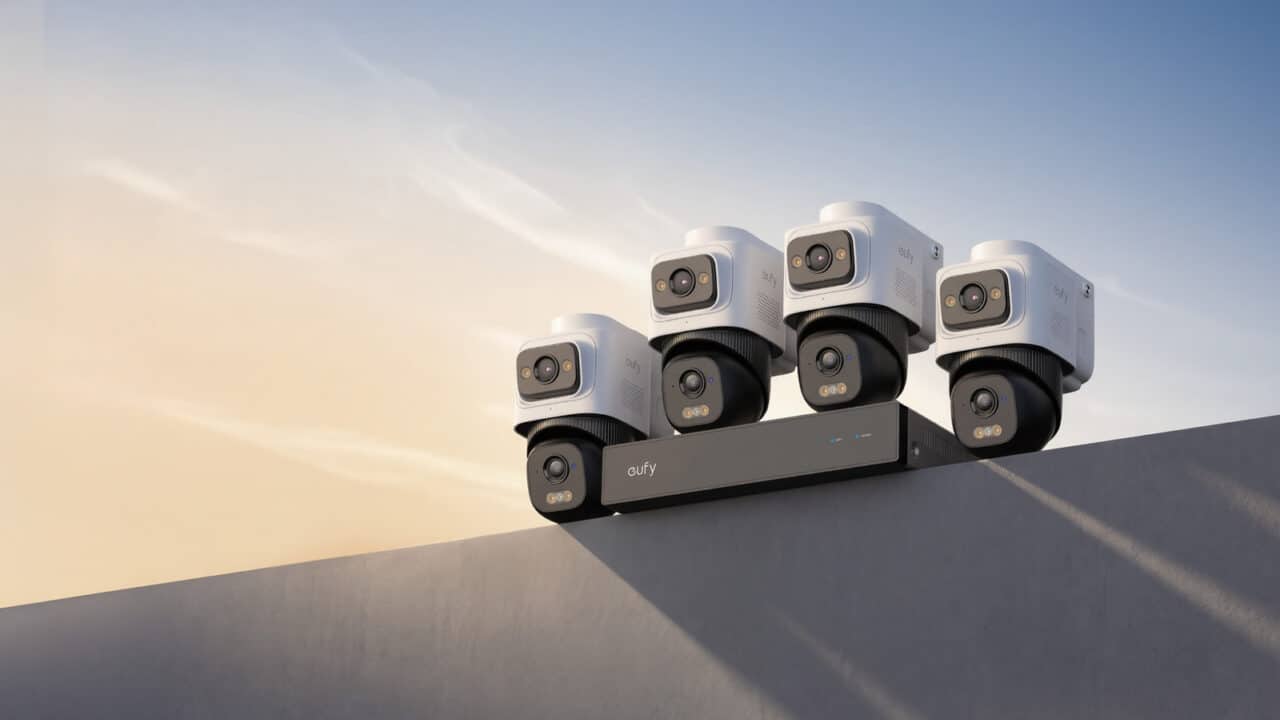
The NVR Security System E50 is eufy’s new multi-camera kit that leans hard on local AI, not cloud processing. It is available now in the United States, Canada, Australia and the United Kingdom, and it centers everything on an NVR box that runs eufy’s AI agent directly on the recorder.
Each camera in the system uses a dual-lens design that pairs a 2K fixed bullet lens with a 4K pan-tilt-zoom lens. eufy says this combo lets the camera keep a wide, detailed overview with the fixed lens while the PTZ lens zooms in for closer views when something happens. The company also says the system uses its OmniTrack AI tracking system and auto-framing to follow motion across the scene.
The on-device AI is not just for tracking a person in a single frame. eufy claims the NVR’s local AI agent can recognize faces and run AI-powered footage searches without sending video to the cloud. It is designed to identify and track people, vehicles, pets and known faces from one camera to the next across the system, so you can see where someone moved around your property. All of that processing happens on the recorder, and eufy says it does not require a subscription.
Video Doorbell S4 brings panoramic AI security to the front door
The Video Doorbell S4 pushes the same no-subscription, on-device AI approach to your front door. eufy describes it as both a wired video doorbell and a security camera, with enough resolution and field of view to capture a full picture of your entryway. The company plans to reach many markets with the S4 later in September 2026.
The S4 captures footage at 9 megapixels with a 3K resolution, which is higher than the typical 1080p or 2K doorbells on the market. eufy says it offers a 180-degree panoramic view, so it can cover more vertical and horizontal area, including packages left close to the door. The doorbell also uses the OmniTrack system, which eufy says lets it track people as they move through that wide field of view, keeping them centered in the frame.
Color night vision is built in as well, so eufy is pitching the S4 as a doorbell that does not drop to a grainy black-and-white image every time the sun goes down. By keeping AI and image processing on the device, eufy positions the S4 as a front-door camera that can spot motion, follow it and capture detail without depending on a cloud back end or a paid plan.
Window Camera E10 focuses on indoor mounting and local recording
The Window Camera E10 is aimed at people who prefer to keep cameras indoors while still watching what happens outside. It mounts directly on a window and records through the glass, which gives another way to monitor yards, driveways or shared outdoor areas without a camera exposed to the elements. eufy plans to release the E10 later in 2026.
For image quality, the E10 records at 2.5K resolution. eufy pairs that with an F1.0 lens and says this allows color night vision, meaning the camera can keep color detail in low-light scenes instead of switching to monochrome. The camera also has a 25-degree adjustable tilt, which eufy says helps reduce blind spots when you are dealing with fixed window positions.
eufy positions the E10 as a 24/7 recording camera rather than a cloud-first product. The idea is that you can let it run continuously in a window, capturing and analyzing footage locally without adding a recurring fee for basic recording and detection.
Fall Detection Sensor targets private spaces without cameras
The Fall Detection Sensor is built for a very different problem: watching for falls in places where you may not want a camera at all. eufy is aiming this at households with an elderly parent or someone with mobility issues, in the kind of private spaces where a camera would not be welcome. A release date has not been announced yet.
Instead of a lens, the sensor uses millimeter-wave radar (often shortened to mmWave) to watch for motion and detect when someone falls. eufy says this gives it the ability to notice a fall without capturing video footage or requiring a wearable device. That makes it more like a small, wall-mounted detector that monitors movement patterns in a room and reacts when they suddenly match a fall event.
The Fall Detection Sensor also includes two-way talk, so caregivers or family can speak to the person in the room if the sensor detects a fall. eufy’s pitch is that the radar-based detection and audio channel give a layer of safety in private areas without adding a camera or asking someone to put on a pendant or smartwatch every day. As with the other products, eufy is framing the intelligence behind these alerts as happening on the device instead of in a remote cloud system.
A single theme: AI handled at home, not in the cloud
Across all four of these products, eufy is leaning on a clear message: the smart part of home security happens locally. The NVR Security System E50 runs face recognition and multi-camera tracking on its own recorder. The Video Doorbell S4 uses on-device AI for 3K, 180-degree tracking at the front door. The Window Camera E10 records around the clock from a window with 2.5K video and color night vision, while the Fall Detection Sensor uses radar and two-way talk to catch a fall without a camera in the room.
eufy ties the NVR, doorbell and window camera together with the promise that you do not need a subscription for those AI-driven features to work. For people who want smart alerts and searchable video without sending everything to the cloud, this group of products is clearly aimed at keeping more of that intelligence inside the home while still expanding the range of what home-security gear can do.
View the original press release.