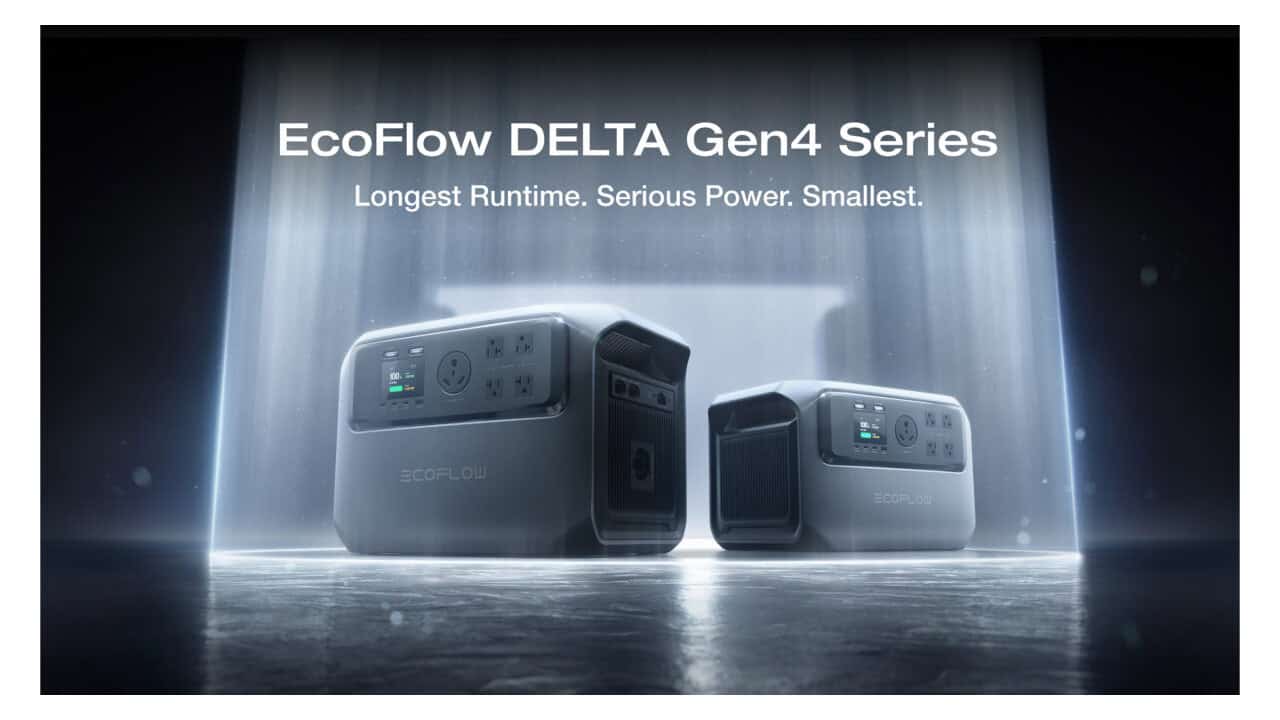
EcoFlow’s new DELTA Gen4 portable power stations are built for storm season, with models aimed at keeping fridges cold, phones charged, and basic home gear running when the grid goes down. The company is pairing those larger home backup units with compact RIVER Gen4 models for grab-and-go power during shorter outages or evacuations. For U.S. homeowners worrying about hurricanes, winter storms, or other extreme weather, the focus is on longer runtimes, lower self-use of power, and lighter designs that are easier to move where you need them.
DELTA Gen4: Home Backup Focused On Longer Outages
The DELTA 3000 Gen4 (3072Wh) and DELTA 3800 Gen4 (3763Wh, expandable up to 12kWh) are designed as core backup units for the home, especially for multi-day outages. Both are available now on EcoFlow’s website and deliver 3600W rated output with 7200W surge power. EcoFlow says both models cut their own power draw by up to 70%, using about 14W with AC turned on and no devices plugged in, and just 3W in standby, compared with industry averages of over 20W and 10W. That low self-consumption lets stored energy go to your appliances instead of being burned by the power station itself.
For storm prep, fridge protection is a big part of the story. The DELTA Gen4 series adds Fridge Runtime Boost, a feature that reduces energy use between refrigerator cooling cycles to stretch how long food stays cold. With that feature switched on, EcoFlow states the DELTA 3800 Gen4 can keep a refrigerator running for up to 70 hours and the DELTA 3000 Gen4 for up to 58 hours, which the company says is 17 hours longer than comparable products in the industry. EcoFlow says the feature helps keep food cold for two to three days during an outage.
Emergency Power Mode And Storm Guard Mode 2.0
For homeowners, another concern during storms is keeping phones and smaller devices alive even if the main battery runs low. The DELTA Gen4 series introduces Emergency Power Mode, which holds back a small reserve of DC power for critical devices such as phones and lights, even when the displayed battery level reaches 0%. The idea is that even if you forget to manage loads during an outage, you still have a safety buffer to recharge communication devices when you need them.
For storm prep, Storm Guard Mode 2.0 uses National Weather Service data in the U.S. to help owners get their power stations ready ahead of severe weather and potential outages. A 10ms UPS switchover helps keep connected electronics running when grid power cuts out. EcoFlow also says DELTA Gen4 retains 99% of its battery charge after one year of storage, so a unit set aside for emergencies is ready when the power goes out.
Smaller, Lighter Designs For Easier Placement
EcoFlow is pitching the DELTA Gen4 series as longer-lasting and, based on its own testing, the smallest and lightest portable power stations in their classes. The DELTA 3800 Gen4 weighs 67.5 lbs. and the DELTA 3000 Gen4 weighs 57.3 lbs., and both have dual side handles. For a homeowner, that matters because you can move a unit from the garage to the kitchen, or from a downstairs outlet to an upstairs office, using those handles. During a storm, that flexibility lets you park the station near whichever room you are using most, whether that is the family room for lights and charging or the kitchen for the fridge and a microwave.
The company positions these units for both home backup and mobile use, so they are suited to situations where you might need to evacuate and bring reliable power with you to a hotel, shelter, or relative’s house. Having one system that works for camping and other outdoor trips but also plugs into your storm plan can make it easier to justify the space it takes in a closet or garage. The focus on smaller footprints and lighter builds is aimed at making that dual use more practical.
RIVER Gen4: Compact Power For Shorter Outages And Evacuations
Alongside the DELTA models, EcoFlow is rolling out the RIVER 260 Gen4 and RIVER 520 Gen4 as part of the same new generation of portable power stations. The RIVER 260 Gen4 offers 256Wh of capacity and 300W output at just over 6 lbs., while the RIVER 520 Gen4 offers 512Wh and 500W output at 10 lbs. While the DELTA Gen4 units lean toward whole-home and large-appliance backup, the RIVER Gen4 series is aimed more at personal electronics, smaller devices, and everyday portability. For homeowners, these can work as secondary backup units for bedrooms, home offices, or to grab quickly if you need to leave during a storm.
The RIVER Gen4 units share the same general goals of compact size and lighter weight, making them easier to store in a closet or keep in a car trunk for emergencies. They are positioned for outdoor adventures and everyday use as well, which means they can fill in during brief neighborhood outages or power blips without needing to wheel out a bigger home unit. Pre-sale for the RIVER Gen4 models is scheduled to begin on November 24, 2026, so they are being aimed at people planning ahead for future storm seasons rather than only reacting when an outage hits.
Planning A Layered Backup Strategy For Your Home
Taken together, EcoFlow’s DELTA Gen4 and RIVER Gen4 series are geared toward a layered approach to backup power for U.S. homeowners. A DELTA 3000 Gen4 or 3800 Gen4 can sit at the center of that plan: Fridge Runtime Boost helps keep food cold for 2 to 3 days per EcoFlow, the low idle draw cuts wasted energy, and Emergency Power Mode reserves some power for critical devices. That combination lines up with what many families look for during hurricane season and other grid disruptions: keep the food safe and communications running without needing fuel or a complicated installation.
On top of that, a smaller RIVER 260 Gen4 or 520 Gen4 can handle phones, tablets, laptops, and a few lights, either in another room of the house or on the road if you have to leave home. Because all of these models are designed to be smaller and lighter, they are easier to move where they are needed instead of being stuck in a fixed spot. For homeowners trying to prepare before the next round of storms, that mix of extended runtime, smarter power use, and portable designs offers a flexible way to build backup capacity around how your family actually lives during an outage.
View the original press release.